



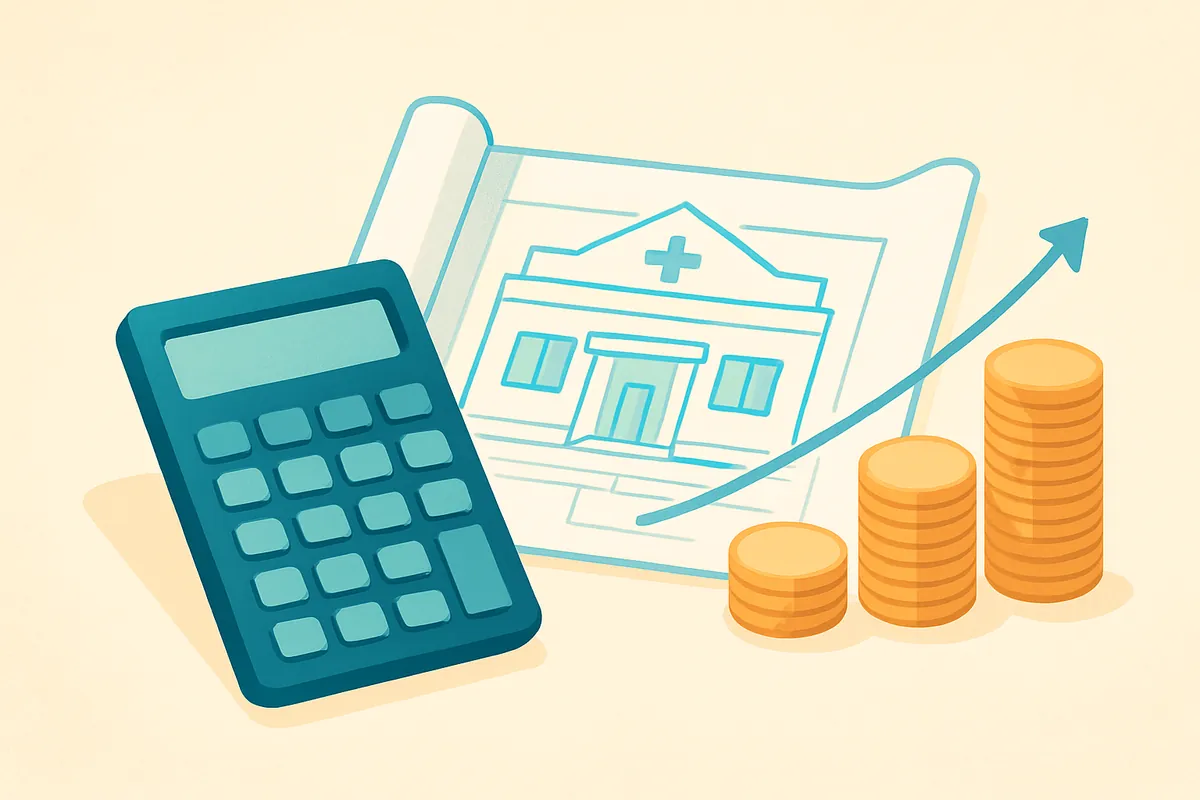
Opening a rehab center in the United States typically costs $50,000 to $150,000 for a basic outpatient program and $500,000 to $2.5 million or more for a residential treatment center or medical detox facility (industry estimates, 2026). The total cost depends on your level of care, location, and whether you lease or build.
That sticker price is only half the story. The cost to open a rehab center that founders quote each other is the build cost, and the build is the easy part. The harder number is the working capital you need to survive the 9 to 18 months between opening the doors and the day insurance actually starts paying.
Undercapitalization is described as the leading cause of treatment center failure, driven by licensing delays, payer credentialing, and a slow census ramp (industry estimate, Behave Health 2026). This step-by-step guide breaks down the cost of opening a drug rehab center by level of care and by category, with sources, and flags the costs most first-time operators miss, from build-out to the working-capital runway.
What Does It Cost to Open a Rehab Center by Level of Care?
Startup costs scale almost directly with the intensity of care you provide. An outpatient counseling practice and a 16-bed medical detox are different businesses with different capital requirements, even though both are "rehab centers." The type of rehab you choose, and the treatment program it supports, sets the floor. The gap between the lowest and highest level of care runs from tens of thousands of dollars to several million, so anchoring your plan to the wrong row can leave you short by millions.
No independently audited study publishes per-level startup benchmarks. The figures below are 2026 industry estimates from behavioral-health consultancies and operator guides, useful as planning ranges rather than precise quotes.
| Level of care | Typical startup cost | What drives the cost |
|---|---|---|
| Standard Outpatient (OP) | $50,000 to $150,000 | Office lease, basic EHR, 1 to 3 clinicians |
| Intensive Outpatient (IOP) | $150,000 to $400,000 | Multiple group rooms, 3+ hours of daily programming |
| Partial Hospitalization (PHP) | $250,000 to $600,000 | 6+ hours of programming, medical and clinical staff |
| Residential (12 to 20 beds) | $500,000 to $1.5M | Facility build-out, 24-hour staffing, accreditation |
| Medical detox (10 to 20 beds) | $750,000 to $2.5M+ | 24-hour nursing, physician oversight, life-safety code |
| Full continuum (detox + residential + PHP + IOP) | $2M to $5M+ | All of the above under one organization |
When you read those ranges, separate one-time capital expenditure (CAPEX) such as build-out and equipment from recurring operating expenses (OPEX) such as payroll, rent, and software. A founder who budgets only for CAPEX runs out of cash before the first insurance check clears.
Is a rehab center a good business? It can be. Residential treatment is estimated to generate $10,000 to $22,000 per occupied bed per month, with break-even typically at 65 to 75 percent occupancy (industry estimate, Behave Health 2026). The demand context is real: SAMHSA counted 14,620 substance abuse treatment facilities offering drug treatment and other rehab services in 2023, against a treatment gap that still leaves most people with a substance use disorder without care (SAMHSA, 2023 N-SUMHSS).
For the full launch roadmap beyond cost, see our guide on how to start a rehab center.
Real Estate and Build-Out: Your Biggest Line Item
The most expensive mistake in this entire process is committing to a facility before confirming zoning and local permitting. Operators have lost $50,000 to $200,000 in deposits and tenant improvements on buildings they were ultimately not allowed to use (industry estimate, Behave Health 2026). Confirm the zoning before you sign anything.
For most operators, real estate and renovation together account for 30 to 50 percent of total startup costs (industry estimate), and the figures vary significantly by market. Lease rates run from roughly $3,000 per month for a small suburban IOP suite to $25,000 per month for a larger rehab facility, and in high-cost metros like Los Angeles or New York a residential-sized space alone can exceed $20,000 to $60,000 per month (industry estimate). Whether you lease or purchase is the single biggest swing in the cost of opening a drug rehab.
Renovation ranges just as widely, from about $50,000 for a minor IOP refresh to $1 million or more for a full residential build-out. As a grounding benchmark, Colorado's 2024 facility cost analysis put new behavioral health construction at roughly $500 per square foot (Colorado DPHCD, 2024).
Build-out cost is driven by requirements that must pass state inspection: ligature-resistant hardware, ADA accessibility, life-safety systems, and minimum group-room sizing. These standards are part of what your state will check during rehab licensing requirements review, so design to them from day one rather than retrofitting later.
Lease versus buy is a cash-flow decision. Leasing preserves capital for working-capital runway, while buying (often through an SBA 504 loan) builds equity but ties up cash you may need to survive the credentialing gap.
How Much Are Licensing and Accreditation Fees?
The application fees themselves are surprisingly small. The real cost is preparing your facility, staff, and a full policies and procedures manual to pass. Licensing requirements include a detailed program description, inspections, and staff credentials, and they vary significantly by state because nearly every state runs licensure through its own department of health or behavioral health authority. Generic estimates quote wildly different licensing numbers because they conflate the fee with the preparation.
A real example: under Florida's Chapter 65D-30 rule, privately funded licensure fees are just $375 for detox, $350 for residential, and $300 for intensive outpatient (Florida DCF, flrules.org). By contrast, California's DHCS raised SUD facility licensing and certification fees by 20 percent effective July 1, 2024, with further annual increases scheduled through FY 2026-27 (California DHCS). Some states also require a Certificate of Need (CON) before you can add beds, a separate approval that can add months and legal expense to your launch timeline.
Accreditation is a separate cost. It is not legally required to open, but many Medicaid and commercial payers require CARF or The Joint Commission accreditation as a condition of network participation. Allow 6 to 12 months for the survey process, because in many states payers will not contract with an unaccredited program (industry estimate).
| Item | Fee | Source |
|---|---|---|
| CARF accreditation | $995 base + $1,525/surveyor/day (about $5,000 to $10,000 for a small single-program org) | CARF schedule via Virginia DMAS (CARF updates annually) |
| The Joint Commission | Annual fee from $1,990/yr + on-site survey from $3,430 for small orgs | The Joint Commission pricing page |
| LegitScript certification | $1,595 application + $3,095 annual, per facility | LegitScript pricing, 2026 |
| DEA registration (prescribers) | $888 per 3-year term | DEA Diversion Control |
If you plan to pursue The Joint Commission route, our explainer on Joint Commission accreditation covers the survey process. Detox and MAT programs that prescribe controlled substances also need a DEA-registered prescriber on staff before they can dispense medication.
Staffing and Clinical Payroll
Payroll starts months before revenue. State surveyors require your key clinical staff to be in place before they will inspect, which means you are paying senior salaries during the licensing wait with zero income to offset them.
The two hardest, most expensive early hires are the Medical Director and Clinical Director. Medical Director compensation in addiction recovery services averages around $226,000, though that comes from a small reported sample and many roles are part-time or contracted closer to $114,000 (PayScale). Clinical Director base salaries typically run $90,000 to $110,000, higher in premium markets, with California's substance abuse program director median at $155,684 (Salary.com, 2024).
Most states require a licensed physician as Medical Director and an advanced-license clinician (LCSW, LPC, or equivalent) as Clinical Director for residential and detox levels of care. Residential and detox programs also need 24-hour nursing coverage, which is the single largest payroll multiplier in the entire model.
Do not under-resource the back office. Case managers, admissions staff, and especially revenue-cycle billers carry the operation. Behavioral health billing is genuinely complex, and hiring a single generalist biller who lacks SUD-specific expertise is a common and costly financial mistake that surfaces months later as denied claims and lost revenue. These payroll commitments feed directly into the working-capital math below.
Insurance, Technology, and Compliance Certifications
These mid-size recurring costs are easy to forget and add up fast. General and professional liability insurance commonly runs $50,000 to $100,000 per year for a treatment center, often at $1 million per occurrence and $3 million aggregate limits, though the range is wide and underwriter quotes vary by facility type and claims history (industry estimate). Get firm quotes during planning, because premiums depend heavily on your level of care and your state.
Your behavioral-health EHR is the core of your technology infrastructure and the next recurring line. Cloud pricing runs roughly $35 to $200 per user per month: TherapyNotes starts around $49, while SUD-focused systems like Kipu run $200 to $600 and enterprise platforms like Netsmart run $500 to $2,000 or more (industry estimate, Behave Health 2026). Budget separately for one-time implementation of $5,000 to $100,000 and data migration of $2,000 to $25,000, costs that surprise nearly every first-time operator. Staff training on the new system typically adds another $1,000 to $10,000 (industry estimate, Behave Health 2026).
Choose an SUD-specific EHR for residential and detox so you get ASAM-criteria workflows and medication-assisted treatment (MAT) tracking, rather than retrofitting a general mental-health tool. General outpatient platforms like TherapyNotes suit low-acuity programs but lack these SUD-specific workflows.
On compliance, your systems and any patient tracking must be HIPAA-aligned, and your marketing engine will need LegitScript certification (covered in the next sections). Treat these as standing operating costs, not one-time setup.
Working Capital: The Cost Almost Nobody Budgets For
The build is the easy part. Surviving until insurance pays is what closes new centers, and undercapitalization is repeatedly cited as the leading cause of treatment center failure (industry estimate, Behave Health 2026). This is the line item that separates founders who make it from founders who do not.
Here is the timeline math, with sources. State licensing takes 3 to 9 months. Insurance credentialing takes 90 to 180 days per payer, and in states with multiple Medicaid managed care organizations (MCOs) you credential with each MCO separately, multiplying the wait. SAMHSA certification for opioid treatment programs adds 4 to 6 months, and LegitScript adds 60 to 90 days (industry estimate, Behave Health 2026).
Now quantify the bleed. National provider-group data shows companies lose $1,000 to $5,000 per provider per day during a 90-day credentialing wait, which is $90,000 to $450,000 in delayed income per provider (Credex Healthcare). A facility with several billing clinicians multiplies that gap, since each one sits un-credentialed until their own application clears.
Credentialing runs through CAQH ProView plus a separate application to each commercial payer and Medicaid MCO, so the paperwork alone is a months-long project. A practical rule of thumb: budget 9 to 12 months of operating capital assuming zero insurance revenue, then another 3 to 6 months at partial capacity while census builds toward the 65 to 75 percent break-even point. Critically, you cannot bill a payer before credentialing is formally confirmed. Submitting claims for un-credentialed services can trigger fraud findings and repayment demands, so the revenue-zero runway is not optional, it is structural.
Marketing and Admissions: The Cost That Decides Whether the Doors Stay Open
You are not opening a sandwich shop. People in crisis and their families will not simply show up because you unlocked the door. Marketing decides whether a $1 million build ever fills beds, and treating it as an afterthought is why well-funded centers fail.
A real marketing strategy is not optional for a new facility, and the figures below come from marketing-agency case studies and industry blogs, not an independently audited study, so treat them as directional. Launch marketing for opening a treatment center commonly runs $10,000 to $50,000, and ongoing spend to fill 20-plus beds runs $10,000 to $30,000 per month.
Addiction treatment is one of the most expensive paid-search verticals, with cost-per-click between $25 and $185 and a minimum viable Google Ads budget near $10,000 per month. Cost per admission is estimated at $1,500 to $15,000 depending on market and conversion process. No independently audited benchmark for cost per admission exists, so use these as planning ranges only.
Three compliance realities shape every dollar of that spend:
- LegitScript first: you cannot run Google, Meta, or Microsoft Bing ads for addiction services without LegitScript certification plus a separate Google Ads account authorization (Google Ads policy). Apply 60 to 90 days before launch.
- EKRA governs pay: the Eliminating Kickbacks in Recovery Act (42 U.S.C. 1320a-7b(g)-(h)) prohibits paying admissions or marketing staff commissions tied to referral volume, across all payers, with penalties up to 10 years and $200,000 per violation (Chapman Law Group). Use salaried roles and marketing-services agreements, not per-admission pay.
- HIPAA-aligned tracking: standard ad pixels on a healthcare site can create privacy exposure, so your analytics and call tracking must be configured to protect patient data.
A specialist healthcare marketing agency that understands LegitScript, EKRA, and HIPAA-aligned tracking can build a compliant admissions engine without the legal exposure that sinks DIY campaigns. Our PPC management for treatment centers and addiction treatment SEO (search engine optimization) pages explain how paid and organic work together from search to admission. Rehab marketing is the one budget line that turns a finished building into a working addiction treatment center.
How Do You Fund a Rehab Center?
Most for-profit treatment centers are financed through SBA loans, private investment, or a blend of both. The SBA 7(a) program lends up to $5 million for working capital, real estate, and equipment. The 504 program lends up to $5.5 million for real estate and equipment, but not working capital. A new SBA rule effective July 4, 2026 raises the combined cap across both programs to $10 million (SBA via HMP Global). SBA loans are for-profit only, expect a 680-plus credit score, and add 60 to 120 days.
Government grants are rarely a startup path. SAMHSA's major programs, State Opioid Response ($4 million minimum per state, about $8.1 billion since FY 2018) and the Substance Use Block Grant ($475 million nationally in FY 2026), flow to state agencies, not directly to facilities (SAMHSA). You reach them through state subgrants and usually must already be licensed to qualify.
Private investors and private equity are active in behavioral health, and many treat a new behavioral health business as an attractive asset, but they expect a credible proforma, a realistic occupancy ramp, and a defensible payer mix.
Many founders also budget for pre-opening planning: a feasibility study ($5,000 to $20,000), a financial proforma (around $5,000), and a business plan (around $5,000), all common but optional (industry estimate). A sober living business plan framework helps if you start with a lower-acuity sober living home before scaling into clinical levels of care.
Plan the admissions engine before you open the doors
Filling beds compliantly from day one takes more than a budget. It takes LegitScript certification, EKRA-safe compensation, and HIPAA-aligned tracking built in from the start. A free strategy audit maps what your launch marketing actually needs.
Get a free strategy auditWhat you will pay to acquire patients
Marketing is one of the largest ongoing line items for a new center, and it is expensive because rehab keywords cost more per click than almost any other category. Representative Google Ads click prices (Ahrefs, United States, June 2026):
| Keyword | Monthly searches | Avg. cost per click |
|---|---|---|
| rehab near me | 14,000 | $14 |
| drug rehab near me | 4,800 | $14 |
| alcohol rehab | 8,400 | $12 |
| inpatient rehab | 7,200 | $16 |
| addiction treatment | 6,000 | $8 |
| detox | 46,000 | $6 |
| drug detox | 3,700 | $7 |
| dual diagnosis treatment | 2,600 | $6 |
For illustration, at $20 per click and a 5 percent click-to-lead rate, that is roughly $400 in ad spend per lead before anyone has spoken to your admissions team, and that is clicks alone. The $400 figure is an illustrative example using a stated assumption, not a benchmark. (Click prices: Ahrefs Keywords Explorer, United States, June 2026.)
Book a free, no-pressure call with the specialists who would run your marketing. You get a clear plan and an honest quote, whether or not we work together.
Frequently Asked Questions
How long does it take to open a rehab center?
Plan for 12 to 18 months from initial planning to the first admission. State licensing review takes 3 to 9 months, insurance credentialing takes 90 to 180 days per payer, LegitScript approval takes 60 to 90 days, and accreditation can take 6 to 12 months. These processes overlap, but each must start early.
Do you need CARF or Joint Commission accreditation to open?
Accreditation is not legally required to open, but many Medicaid programs and commercial payers require it to join their networks. CARF runs about $5,000 to $10,000 in survey fees for a small single-program organization. The Joint Commission starts at $1,990 per year plus an on-site survey fee from $3,430. Most programs pursue one within their first 12 to 18 months.
Do I need a medical director to open a rehab center?
Yes, in most states, for residential and medical detox levels of care. State rules typically require a licensed physician to serve as Medical Director with clinical oversight responsibility, alongside an advanced-license Clinical Director. Lower-acuity outpatient models may have lighter requirements, but you should confirm the specific rules with your state licensing authority before hiring.
Can I open a rehab center without a clinical background?
Yes. Many treatment center owners are operators or investors rather than clinicians. You hire licensed clinical leadership, a Medical Director and Clinical Director, to carry the clinical responsibility. You need a working grasp of state regulation, payer credentialing, EKRA and HIPAA boundaries, and enough capital to survive the revenue-zero runway.
Can I pay admissions staff a commission per patient?
No. EKRA (42 U.S.C. 1320a-7b(g)-(h)) prohibits compensation tied to patient referral volume for recovery homes and clinical treatment facilities, across all payers including commercial insurance and self-pay. Penalties reach up to 10 years imprisonment and $200,000 per violation. Use salaried roles and marketing-services agreements, and consult a healthcare compliance attorney before structuring admissions pay.
Is a rehab center profitable?
It can be. Residential treatment is estimated to generate $10,000 to $22,000 per occupied bed per month, with break-even around 65 to 75 percent occupancy (industry estimate, 2026). Profitability hinges on census management and payer mix. The most common reason centers fail is undercapitalization, not weak demand.
Can I get a government grant to open a rehab center?
Rarely as a startup. SAMHSA's main grants (State Opioid Response and the Substance Use Block Grant) go to state agencies, which subgrant to providers that are usually already licensed. For for-profit startups, SBA loans (up to $10 million combined from July 2026) are a more reliable financing path.
Sources
- SAMHSA - 2023 N-SUMHSS Annual Report
- Florida DCF - Chapter 65D-30 Substance Abuse Licensure Fee Schedule
- California DHCS - Licensing and Certification Applications, Forms, and Fees
- CARF (via Virginia DMAS) - CARF Accreditation Fees, US
- The Joint Commission - Behavioral Health Care and Human Services Pricing
- LegitScript - Addiction Treatment Certification Pricing
- Google Ads - Healthcare and Medicines Policy (Addiction Services)
- Chapman Law Group - EKRA: Eliminating Kickbacks in Recovery Act
- Colorado DPHCD - 2024 Facility Sizing and Cost Analysis
- Credex Healthcare - How Credentialing and Licensing Impact Your Revenue Cycle
- SBA via HMP Global - SBA Raises 7(a)/504 Loan Cap to $10 Million
- SAMHSA - Block Grants (SOR / SUBG)
- PayScale - Medical Director, Addiction Recovery Services Salary
- Salary.com - Substance Abuse Program Director Salary, California