



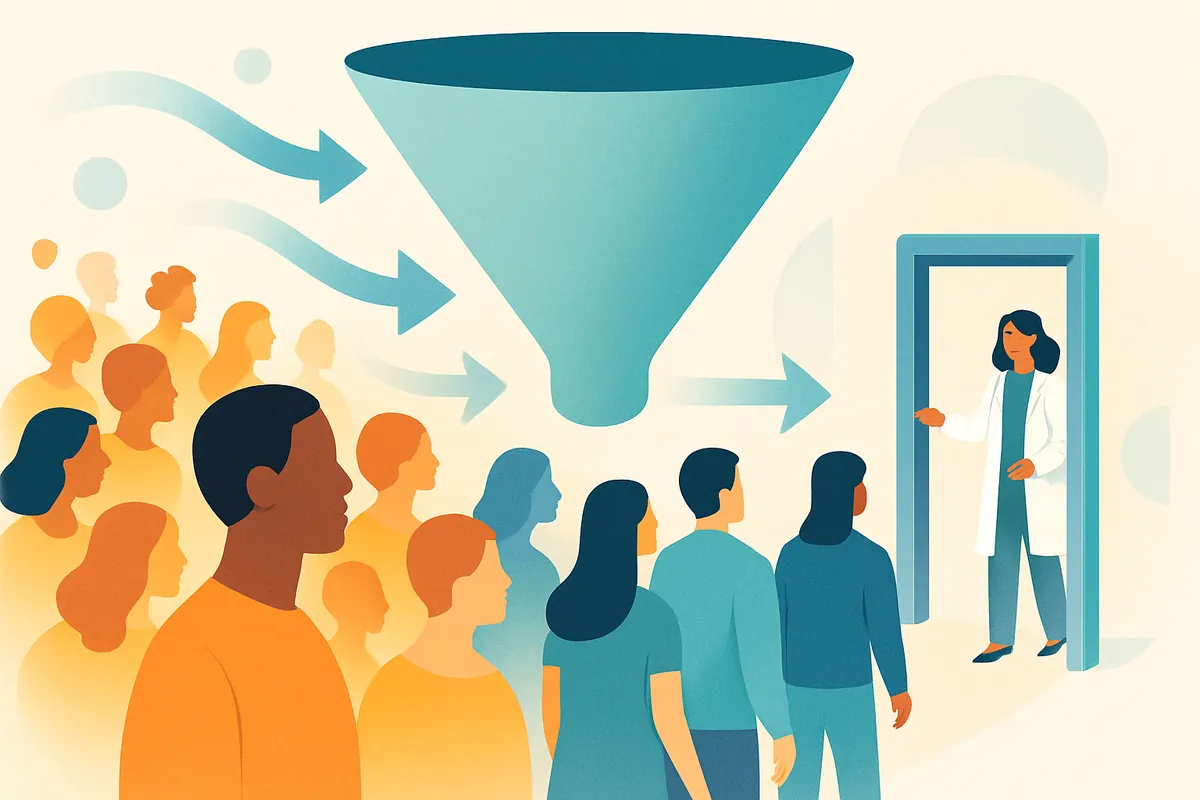
In 2023, an estimated 48.5 million people aged 12 or older had a past-year substance use disorder, yet only about 14.6% of them received any substance use treatment (SAMHSA, 2023 NSDUH). Most of the people your center exists to help are not searching for you today. That single fact is the whole argument behind rehab demand generation vs lead gen, and getting the balance wrong quietly caps your census. This guide breaks down what each one is, how they fit together, and how to decide where your next dollar should go.
What is the difference between demand generation and lead generation?
Demand generation creates awareness and trust among people who are not yet ready to call. Lead generation captures the contact details of people who are. One warms the market, the other harvests it. They sit at different points of the same funnel, and treating them as rivals is where most marketing budgets go sideways.
Demand generation is a top-of-funnel strategy. It educates families in your target audience, builds brand awareness, and plants your name before anyone types “drug rehab near me.” Think ungated guides, organic search content, video, and clinical thought leadership. According to Cognism, demand generation is measured in brand search volume, traffic, and engagement, not form fills.
Lead generation is a mid- and bottom-of-funnel activity. Lead generation is the process of converting existing intent into a named contact: a verification-of-benefits form, an inbound call, a chat that turns into an assessment. It is measured in qualified inquiries and cost per admission.
| Factor | Demand Generation | Lead Generation |
|---|---|---|
| Funnel stage | Top (awareness) | Middle and bottom (intent) |
| Goal | Build awareness and trust | Capture contact details |
| Typical tactics | Ungated content, SEO, video, PR | VOB forms, paid search, call tracking |
| Content | Mostly ungated, free to consume | Often gated or action-based |
| Primary metric | Brand search, traffic, engagement | Qualified inquiries, cost per admission |
| Time to result | Months, compounding | Days to weeks, immediate |
The cleanest way to remember it: lead generation is the result of demand generation done well. The differences between demand generation vs lead generation come down to funnel stage, not competing tactics. If nobody knows your name, your forms stay empty no matter how good they are.
Why this distinction matters for treatment centers
For a treatment center, the demand-versus-lead question is not academic. It decides whether you are building a referral engine or renting one.
Here is the operational reality. The pool of people in active crisis searching this week is small and fiercely contested. Paid search for addiction terms is among the most expensive in all of healthcare, and you are bidding against every other center in your market for the same handful of high-intent clicks. If lead generation is your only strategy, you are locked in a permanent auction with no equity to show for it.
To create demand, your center needs visibility before a family starts searching. Unlike b2b marketing, where awareness cycles run long, treatment decisions compress quickly once crisis hits. Demand generation changes the math. When a family spends three weeks reading your content on detox, levels of care, and what aftercare looks like, you are no longer a stranger when they finally call. You are the center they already trust. Demand generation builds trust long before an inquiry, and that shortens the admissions conversation and lifts conversion on the leads you do capture. This is the difference between marketing that reports clicks and marketing that reports admissions.
There is also a compliance dimension that pure lead-buying ignores. Treatment centers operate under the Eliminating Kickbacks in Recovery Act (EKRA), which makes it a federal crime to pay or receive remuneration for referring a patient to a recovery home, clinical treatment facility, or laboratory. Paying a marketer a commission tied to patient referrals, even a single private-pay referral, can carry penalties of up to 10 years in prison and a $200,000 fine per occurrence (U.S. Department of Justice). Buying “leads” on a per-admission basis is exactly the structure EKRA was written to stop. Owning your demand generation sidesteps that risk entirely.
How do demand generation and lead generation work together in admissions?
They work together as one continuous path from first search to admission, not as two separate campaigns. The mistake is funding one and starving the other.
Picture the journey. A mother whose son is using opioids searches “is my child addicted” at 1 a.m. That is demand-stage behavior. She is not ready to admit anyone. If your educational content meets her there, answers her question honestly, and treats her with dignity, you have entered her consideration set. Two weeks later she searches “residential treatment [your city] insurance.” That is lead-stage behavior, and now your name carries weight her cold competitors cannot match.
Think of demand gen as the infrastructure that makes lead gen more efficient: demand gen creates awareness, lead gen zeroes in on capturing it. A healthy admissions engine runs both layers at once:
- Demand layer: SEO-driven educational content, family guides, clinician-authored explainers, and brand presence in AI search results. This fills the top of the funnel, nurtures potential buyers toward inquiry, and compounds month over month. Our approach to content marketing for rehab centers is built specifically for this layer.
- Capture layer: conversion-focused landing pages, fast verification-of-benefits flows, click-to-call, and tightly tracked paid search for treatment centers. This harvests the intent your demand layer helped create.
- Conversion layer: speed to lead. Every minute of delay after an inquiry loses people in crisis. The best demand and lead programs are wasted if the phone rings out.
Once a buyer raises their hand, lead scoring helps your admissions team prioritize callbacks. When the layers are connected, demand generation lowers your cost per admission over time because more of your traffic already knows and trusts you. When they are disconnected, you overpay for cold leads forever.
How to decide which to prioritize for your center
Start with capacity, not preference. The right balance depends on where your center sits today, and the honest answer for most operators is “both, in sequence.”
Your marketing team should use these criteria to weight your demand generation strategy:
- Bed availability: If you have empty beds this month and payroll is due, you need the speed of lead generation now. Demand generation cannot fill a bed by Friday. If you are running near capacity, shift investment toward demand to build durable, lower-cost pipeline.
- Market maturity: In a saturated metro where paid clicks are punishing, demand generation is how you escape the auction. In an underserved area, lead capture may convert cheaply enough to lead with.
- Payer mix: If you depend on a specific insurance population, demand content that explains coverage and levels of care pre-qualifies families before they call.
- Budget runway: Lead generation shows results in weeks; demand generation compounds over months. If you can only fund one for a quarter, fund capture, then reinvest early wins into demand so you are not renting leads forever.
- Timeline: Match the tactic to the horizon. Quarter-end census pressure points to lead gen. A 12-month growth plan points to demand gen as the foundation of your generation strategies.
A practical sequence for a growing center: stabilize census with disciplined lead generation for rehab centers, then layer in demand generation so that within a year a meaningful share of admissions comes from people who already knew your name. The goal is to make paid capture cheaper every quarter, not to depend on it forever. These are not competing marketing strategies; they are sequential phases of the same engine. Use demand gen to build awareness; use lead gen to harvest it.
What compliance pitfalls should you avoid?
The biggest risks in rehab lead generation are legal, not creative. Two regulations shape what you can and cannot do, and ignoring them can end a license or a career.
EKRA and pay-per-lead arrangements. Any deal that ties marketer payment to admissions or referrals can violate EKRA. That includes buying leads priced per admission and paying call centers a bounty per intake. Structure marketing as flat-fee or retainer services for work performed, never as a commission on patients. When you evaluate a “leads” vendor, the payment model matters more than the lead price.
LegitScript and platform rules. To run addiction-treatment ads on Google, Meta, Microsoft, and similar platforms, your center must hold LegitScript certification. According to LegitScript, certified advertisers may not misrepresent treatment efficacy, costs, or amenities, and lead generators that refer patients to other providers for compensation are explicitly disallowed. Google’s healthcare policy enforces this through its addiction services certification, and ads currently run only in approved countries such as the United States, Australia, Ireland, and New Zealand.
A few more traps to avoid:
- FTC and testimonials: reviews and outcome claims must be truthful and properly disclosed. “Results not typical” disclaimers alone are not enough under current FTC guidance.
- HIPAA-aligned tracking: pixels and retargeting on a treatment site carry patient-privacy implications. Build tracking that respects 42 CFR Part 2 and HIPAA from the start.
- Stigma-safe language: use “person with a substance use disorder,” not “addict,” and “in recovery,” not “clean.” This is both an ethical standard and a trust signal that converts.
Compliance is not a tax on growth. In this industry, it is the moat. Centers that market ethically build the trust that actually fills beds.
How do you evaluate a demand gen or lead gen partner?
Judge a partner by how they get paid and what they measure, not by the volume they promise. The wrong incentive structure can put your license at risk; the wrong metric wastes your budget.
Ask any prospective agency or vendor these questions:
- How are you compensated? Flat fee or retainer is EKRA-safe. Per-admission or per-referral pricing is a red flag. Walk away from anyone who prices leads by the patient.
- Do you own the assets? Demand generation should build equity you keep: your site, your content, your rankings. If the program collapses the moment you stop paying, it was rented lead gen wearing a demand-gen label.
- What do you report? Vanity metrics like impressions and raw lead counts hide the truth. Ask for cost per admission, qualified-inquiry rate, and speed-to-lead benchmarks.
- How do you handle compliance? A credible partner can explain EKRA, LegitScript, FTC testimonial rules, and HIPAA-aligned tracking without hesitating. If they cannot, they will eventually expose you.
- Who reviews clinical claims? In behavioral health, content should pass clinical review for accuracy and ethics before it goes live. Generic agencies skip this. It matters.
Effective demand generation builds equity that compounds; lead generation campaigns stop the moment budget does.
Build an admissions engine, not a lead bill
You do not have to choose between filling beds this quarter and building durable pipeline. Demand gen and lead gen are not rivals, they are two phases of the same admissions engine, and the right mix does both. Addiction Marketing Agency is a marketing agency built exclusively for addiction treatment and behavioral health centers, with an in-house clinical team that reviews every campaign for accuracy, ethics, and compliance before it launches.
We will map your current demand and capture layers, show you where census is leaking, and build a plan that lowers your cost per admission over time. One client per area, EKRA-safe by design.

Book a free, no-pressure call with the specialists who would run your marketing. You get a clear plan and an honest quote, whether or not we work together.
FAQ
Is demand generation or lead generation better for a new treatment center?
For a new center with empty beds, lead generation usually comes first because it produces inquiries in weeks, not months. But pure lead buying keeps you in a permanent auction. The stronger play is to stabilize census with compliant lead generation, then reinvest early wins into demand generation so that within a year more admissions come from families who already trust your name.
Does demand generation violate EKRA?
No. Demand generation, building awareness through content, SEO, and brand presence, does not involve paying for patient referrals, so it sits well clear of EKRA. The EKRA risk lives in lead generation structured as pay-per-admission or per-referral commissions. Keep marketing on flat-fee or retainer terms for work performed, and you avoid the arrangement EKRA prohibits.
Why are addiction treatment leads so expensive?
Paid search for addiction treatment is among the costliest in healthcare because a small pool of high-intent searchers is contested by many centers at once. Every center bids on the same urgent keywords. Demand generation eases this by building an audience that already knows you, so a larger share of your inquiries arrive warm rather than through expensive cold clicks.
What is the difference between demand generation and lead generation in simple terms?
Demand generation builds awareness and trust among people who are not ready to call yet. Lead generation captures the contact information of people who are. Demand generation warms the market; lead generation harvests it. Lead generation is essentially the payoff of demand generation done well, which is why the strongest admissions programs fund both at once.
Do I need LegitScript certification for both?
You need LegitScript certification to run paid addiction-treatment ads on Google, Meta, and similar platforms, which is mostly a lead-generation activity. Organic demand generation through SEO and content does not require it, though your site must still meet platform and FTC standards. Most centers pursue certification early so their capture layer can use paid channels without interruption.
How do I measure whether demand generation is working?
Track leading indicators that precede admissions: branded search volume, organic traffic to educational pages, time on treatment-program pages, and the share of inquiries that mention finding you through content or search. Over several months, a working demand program should lower your blended cost per admission as more traffic arrives already familiar with your center.
Sources
- SAMHSA - “2023 National Survey on Drug Use and Health (NSDUH) Releases”
- Cognism - “Lead Generation vs Demand Generation: A Side-by-Side Comparison”
- U.S. Department of Justice - “Eliminating Kickbacks in Recovery Act enforcement”
- LegitScript - “Addiction Treatment Certification: Ads & Marketing”
- U.S. Federal Trade Commission - “Health Products Compliance Guidance”